

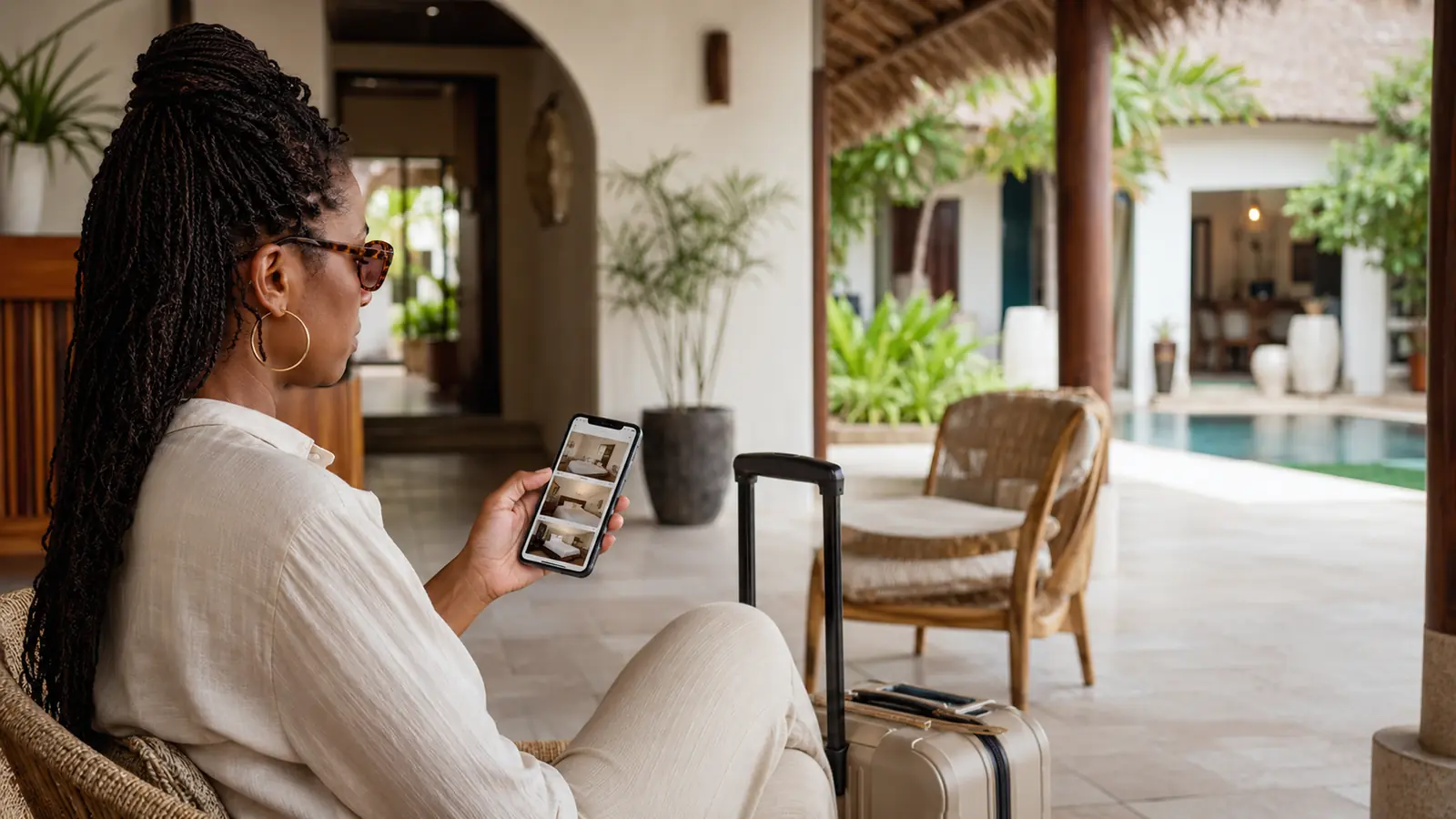
A guest can love the hotel and still fail to book it.
The photographs may be beautiful. The property may have strong reviews. The location may fit perfectly. But on a phone, the room types are difficult to compare, rates are unclear, the booking tool feels disconnected, WhatsApp opens without context and nobody owns the follow-up.
The website did its visual job. The booking journey failed.
For a hotel in The Gambia, this path often has to serve two audiences at once: a guest planning from abroad and a local or regional customer deciding quickly from a phone. Both need confidence, but not always the same information.

The guest experiences one decision
Hotels often manage digital channels as separate projects:
- the website
- the booking engine
- online travel agencies
- the property management system
- guest communication
The boundaries between systems are invisible to the guest, who is trying to answer a sequence of practical questions:
- Is this the right property for my trip?
- Which room fits?
- Is it available on my dates?
- What is included?
- What will I pay?
- Can I trust the process?
- What happens after I enquire or book?
Every unclear transition creates another chance to leave.
Mobile is the real front desk
For many guests, the first serious interaction with the hotel happens on a phone.
They may arrive from Google Maps, Instagram, an article, a recommendation or an online travel agency. The page must load quickly, establish the property clearly and make the next action obvious.
A useful mobile experience should make it easy to understand:
- the type and atmosphere of the property
- its actual location
- room differences
- essential facilities
- current offers and booking conditions
- transport or arrival support
- how to check availability
- how to speak to a person
The homepage needs enough information to remove uncertainty and move the guest to the next step.
Room content should help a decision
Room pages often contain names and photographs but very little decision support.
“Deluxe”, “premium” and “executive” mean different things at different hotels. Guests need concrete differences: bed configuration, occupancy, size where confirmed, view, outdoor space, accessibility, included services and the reason to choose one room over another.
Strong room content answers:
- Who is this room best for?
- How many guests can it accommodate?
- What makes it different from the category below or above?
- Which photographs belong to this exact room?
- What is included in the displayed rate?
- Can the guest check dates or enquire from this page?
Clarity reduces repetitive questions and makes staff conversations more productive.
Availability should not become a dead end
The booking engine is part of the hotel experience even when it is supplied by another platform.
Common failure points include:
- dates resetting during the handoff
- rooms shown without enough information
- unclear taxes or inclusions
- poor mobile layout
- unavailable results with no alternative
- a different visual identity that reduces trust
- no clear route to ask a question
- rates that do not agree across channels
If instant online booking is not practical, the alternative should still be structured. An enquiry can capture dates, number of guests, room interest and contact preference before reaching the reservations team.
“Message us” is weaker than a conversation that begins with useful context.
WhatsApp needs an operating process behind it
WhatsApp can be one of the strongest hotel conversion channels. It is familiar, direct and human.
It becomes fragile when:
- several people assume someone else replied
- requests remain on personal phones
- availability must be checked manually in another system
- quotations are inconsistent
- no next action is recorded
- the hotel cannot see which enquiries became bookings
The channel can remain WhatsApp while a lightweight process captures the enquiry, assigns an owner, records the offer and schedules follow-up.
The guest sees a natural conversation. The hotel gains control behind it.
The WhatsApp and CRM guide shows how to create that ownership without turning the guest conversation into a robotic form.
Direct booking needs a reason
Hotels should not assume guests will book directly simply because the website exists.
The direct route needs a clear advantage. That advantage does not always need to be a lower price. It may be:
- a more flexible conversation
- airport transfer coordination
- a room-selection recommendation
- a direct-booking inclusion
- local concierge support
- clearer modification terms
- a curated package
- confidence that a person will help
The value should be genuine, operationally deliverable and visible at the moment of decision.
Measure the full path
Page views alone do not explain booking performance.
Useful questions include:
- Which source brought the enquiry?
- Which room or offer created interest?
- Where do users leave the process?
- How long does a meaningful response take?
- How many enquiries receive a clear next action?
- Which questions repeat most often?
- Which enquiries convert, and why are others lost?
The purpose of measurement is not to create a large dashboard. It is to identify where guests experience uncertainty and where staff lose control.
Fix the booking path
A hotel website is the working front door for a booking journey.
It is the customer-facing layer of a larger system connecting discovery, room choice, availability, enquiry, booking, arrival and guest communication.
Palmward designs that complete journey around the property’s real operation and existing platforms. Sometimes the right answer is a better website. Sometimes it is a cleaner handoff, a structured WhatsApp flow, clearer room content or better ownership behind the enquiry.
The outcome matters more than the number of tools: help the right guest understand the property, take the next step and receive a reliable response.
If the property is reviewing the complete digital front door, use the website design guide for businesses in The Gambia alongside this hotel checklist.


.jpg)