Battery quotations often start with a product.
Good sizing starts with a table.
For each critical device, record its measured running power, expected hours of use and any startup demand. Then calculate the energy the operation needs, not the capacity a seller happens to have in stock.
Know the two numbers
Kilowatts, kW
This is power at a moment in time.
The inverter must support the combined operating load and short startup demand from motors or compressors.
Kilowatt-hours, kWh
This is energy over time.
The battery must provide enough usable energy for the desired runtime after conversion losses and reserve are considered.
A large kWh battery with an undersized inverter may not start a pump. A large inverter with a small battery may support the load but only for a short time.
Step 1: list only critical loads
Example:
| Load | Measured power | Required use |
|---|---|---|
| Provider terminal and router | 35 W | 6 h |
| Network switch and two access points | 55 W | 6 h |
| CCTV recorder and cameras | 70 W | 6 h |
| Four LED lights | 40 W | 4 h |
| Checkout device and POS | 60 W | 6 h |
| Small refrigerator, average while cycling | 120 W | 6 h |
This example has 380 W of listed operating load before any diversity or startup analysis.
Do not use a generic refrigerator figure for a real installation. Measure it over time.
Step 2: choose the operating mode
Decide whether the system must provide:
- safe shutdown
- a bridge to generator
- two hours of normal operation
- six hours of reduced operation
- overnight essentials
- extended operation with solar
The same building can require a 1 kWh bridge system or a much larger overnight system depending on this decision.
Step 3: calculate usable energy
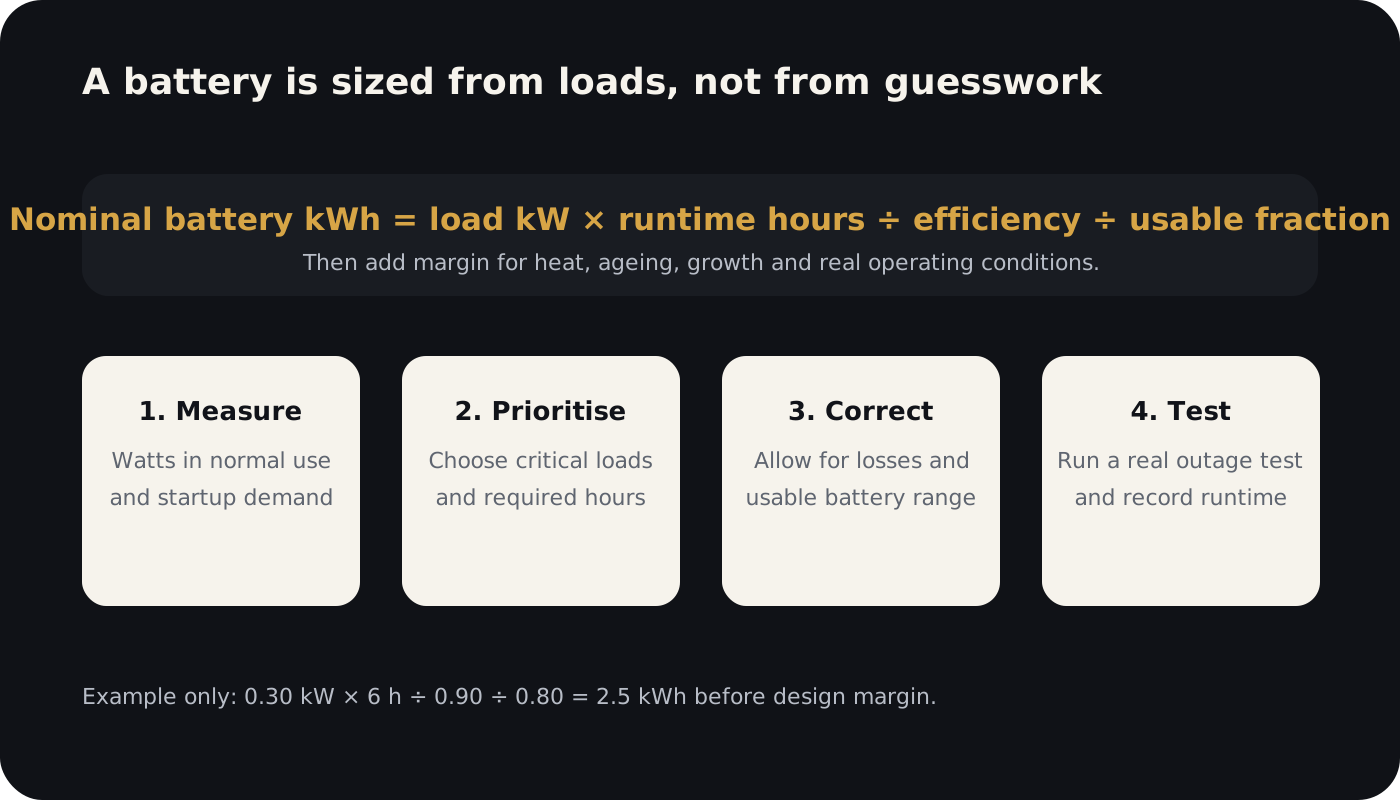
A simple first estimate is:
Load in kW × runtime in hours = usable energy required
For a steady 0.30 kW critical load required for 6 hours:
0.30 × 6 = 1.8 kWh
The battery must deliver more than 1.8 kWh nominal because the inverter consumes energy and the design may reserve part of the battery capacity.
If the assumed inverter efficiency is 90% and the planned usable battery fraction is 80%:
1.8 ÷ 0.90 ÷ 0.80 = 2.5 kWh nominal
That is before design margin for heat, ageing, uncertainty and growth.
Step 4: check startup and peak power
Refrigerators, freezers, pumps, compressors and some printers can draw higher power when starting.
The inverter and battery must support:
- continuous combined load
- brief startup demand
- power factor where relevant
- simultaneous starts
- protective device behaviour
If two compressors restart together after a grid return, the peak may be different from normal operation.
Professional measurement and manufacturer data should be used for motor loads.
Step 5: add sensible margin
Margin covers:
- conversion losses
- cable losses
- battery ageing
- high ambient temperature
- inaccurate nameplates
- modest future growth
- the fact that users do not operate exactly as planned
Margin should not be used to avoid measurement. Oversizing every assumption can make the system unnecessarily expensive.
Step 6: confirm charging capacity
A battery that can run for eight hours still needs to recharge.
Check:
- available grid charging power
- solar array size and realistic daily production
- generator charging capacity
- inverter charge limit
- battery charge limit
- time available before the next outage
- whether charging competes with normal building load
This is especially important when cuts are frequent. A large battery that never returns to full usable charge will not deliver its planned runtime.
Step 7: test the installed system
Run a controlled outage using the actual critical loads.
Record:
- initial battery state
- load in watts
- transition behaviour
- runtime
- minimum battery state
- inverter temperature
- any overload or fault
- internet and payment availability
- recharge time
Use the result to adjust settings and the operating procedure.
A home example
A home that protects Wi-Fi, lights, cameras, fans, charging and a refrigerator may have a modest average load but occasional peaks.
The design should separate those circuits from air conditioning, electric cooking and water heating.
A small business example
A shop may need a similar energy capacity but stricter transition behaviour because a POS session, camera recorder or network gateway should not reboot.
That can justify a dedicated UPS for sensitive equipment even when a larger battery system protects the circuit.
The home lithium guide covers equipment and safety checks. The small business load guide helps decide what belongs on the critical circuit.
Palmward can measure the technology load, map the service dependencies and define the operating target before qualified electrical design and installation are finalised.