“Eco” is easy to print on a sales brochure.
The buyer notices something else.
Does the house stay comfortable when the grid fails? Does the internet work in every room? Are water pumps, gates, cameras and common lighting protected? Who maintains the batteries after handover? Can another provider connect without digging up the road?
The real premium is continuity designed into the property.
Sell an operating standard
A developer should define the service level before selecting products.
For example:
- essential power transfers automatically
- each home receives a stated battery-backed circuit
- shared gates, cameras, pumps and lighting have protected power
- the development is prepared for more than one internet provider
- internal Wi-Fi coverage is designed, not guessed
- residents can see system status
- faults are monitored
- maintenance and replacement responsibilities are documented
This is more credible than promising “24/7 power” without stating the load, runtime, weather assumption or generator support.
Separate private and shared loads
Each home may have a critical circuit for:
- lights
- refrigerator
- Wi-Fi
- cameras
- fans
- charging
- selected sockets
The shared system may protect:
- entrance and access control
- common cameras
- security office
- water pump controls
- borehole or storage monitoring
- common lighting
- communications cabinet
- fire or safety systems where present
Air conditioning and heavy appliances need explicit treatment. Do not let sales language imply that every load will run indefinitely.
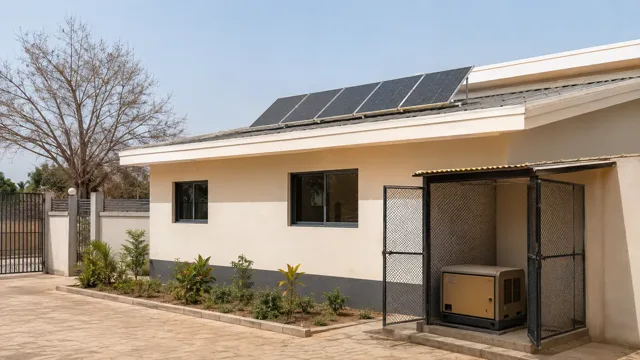
Choose the power architecture
Possible approaches include:
Individual systems
Each home has its own inverter, battery and solar allocation.
Advantages can include clear ownership and metering. Challenges include duplicated equipment, variable maintenance and space in every unit.
Shared system
A central plant serves multiple homes and common infrastructure.
Advantages can include professional maintenance and efficient shared capacity. Challenges include distribution complexity, billing, fairness and a larger single point of failure.
Hybrid approach
Common infrastructure has a managed shared system while each home receives a defined essential backup layer.
This can balance ownership and continuity.
The choice should be made with electrical, commercial, legal and maintenance input.
Design the internet before the road is finished
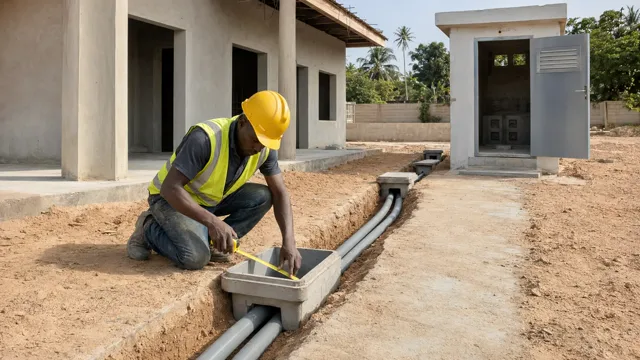
The cheapest time to provide telecom pathways is during civil works.
Include:
- provider demarcation space;
- spare ducts;
- pull boxes;
- protected routes to every unit;
- equipment room power and ventilation;
- earthing;
- internal data cabling;
- ceiling access point locations;
- as-built drawings;
- space for a second provider.
Being fibre-ready does not make the developer an internet service provider. Activation and public service should involve authorised operators and current regulatory requirements.
The fibre-ready development guide gives the passive infrastructure checklist.
Build continuity across power and internet
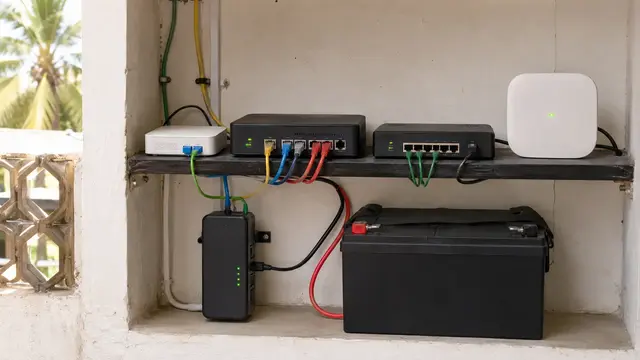
The network equipment room needs protected power.
A development can have fibre at the gate and still go offline when:
- the ONT loses power;
- the shared switch turns off;
- the backup connection is not protected;
- access points are on general circuits;
- the equipment room overheats;
- the gate system depends on a dead network.
Power and connectivity should be tested together.
Add water and security to the same operating view
Residents experience infrastructure as one service.
Useful monitoring can include:
- grid and backup state
- battery alarms
- solar production
- water tank level
- pump faults
- gate availability
- common lighting
- camera recorder status
- internet path
- equipment-room temperature
Do not create an app for its own sake. Use a simple dashboard and alerts that lead to named maintenance actions.
Plan maintenance before sales
The developer or estate manager should document:
- who owns each asset
- who pays for replacement
- service intervals
- cleaning responsibility
- spare parts
- warranty claims
- fault response
- resident support
- safe battery disposal
- system expansion
A development sold as maintenance-free will lose trust when the first battery, pump or access point fails.
Market the proof, not the adjective
Strong property claims are measurable:
- “Essential circuit designed for X kWh usable energy”
- “Shared security and gate systems on protected power”
- “Two independent internet pathways prepared”
- “Every unit has wired data points and planned Wi-Fi coverage”
- “Monthly continuity report for common systems”
Claims should match the final installed and tested system.
The solar, battery and generator guide helps choose the power mix. The internet continuity guide covers the complete network path.
Palmward can help the developer define the resident experience, technology topology, monitoring and handover standard before individual contractors make disconnected decisions.