Ask ten business owners about electricity and you will get ten different answers.
One shop may lose power for a short period. Another may face several interruptions in the same day. A hotel near one feeder can have a different experience from an office a few streets away. Planned work, generation shortages, local faults, voltage problems and building-level electrical issues are often described with the same words: the light went.
There is no public live counter that gives a reliable national total of every interruption experienced by every customer. There is, however, a recent business dataset that gives us a useful benchmark.
The strongest recent business figure
The World Bank Enterprise Survey for The Gambia interviewed owners and senior managers at 162 formal private firms between May and September 2023.
It found that:
- 87% of firms experienced electrical outages
- firms reported 8 power outages in a typical month
If a typical month with eight interruptions repeated for twelve months, the simple annualised illustration would be about 96 interruptions. That is not an official annual outage count. It is only a way to make the monthly answer easier to understand.
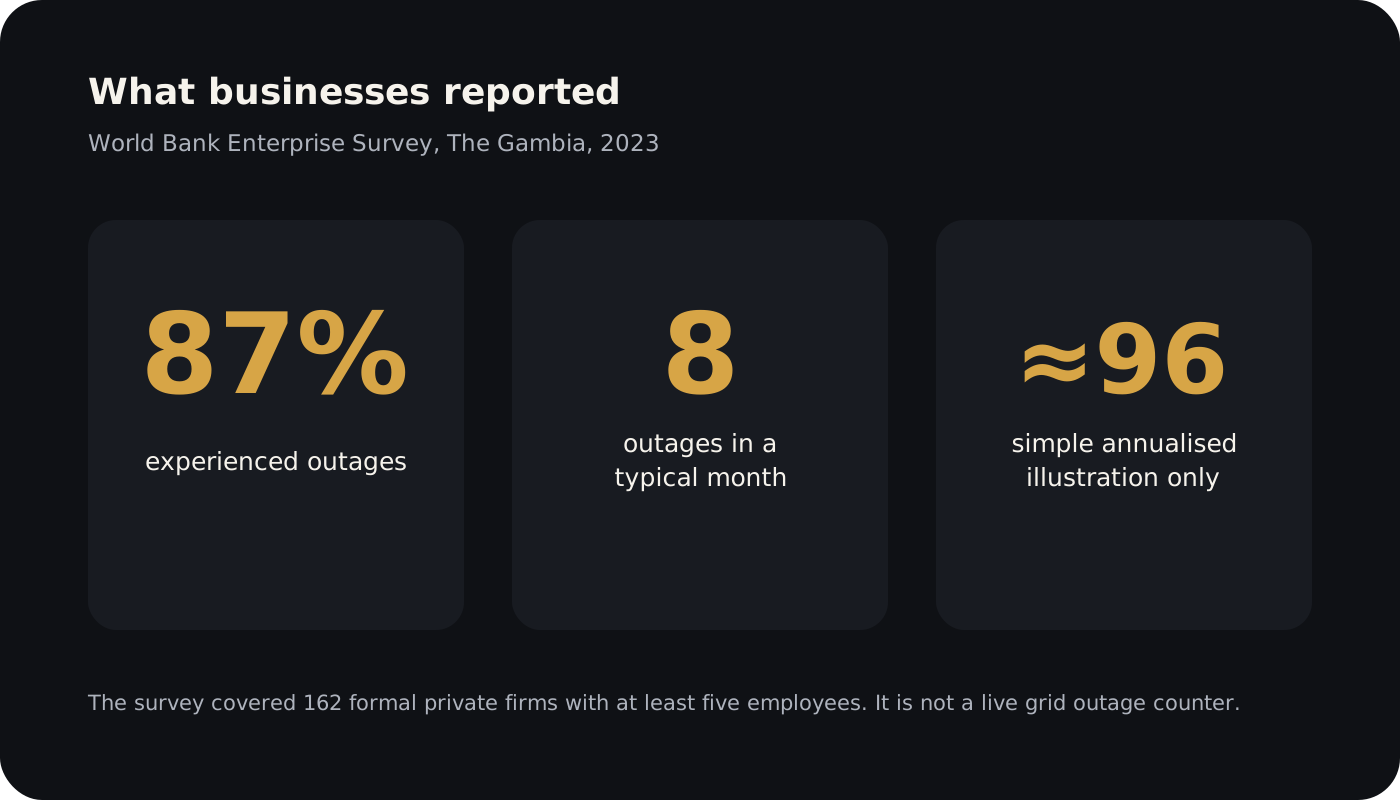
The survey also has limits. It covered registered private businesses with at least five employees. It did not cover every household, microbusiness, public utility or informal seller. The figures describe what businesses reported for their last fiscal year, not what is happening on the grid this minute.
That still makes the result commercially important. A problem affecting 87% of surveyed firms should be treated as a normal operating condition, not a rare emergency.
Access and reliability are different
More people can receive an electricity connection while existing customers still experience interruptions.
This distinction matters because The Gambia has made significant infrastructure progress. The World Bank reported in 2025 that the country commissioned a 23 MWp solar park with 8 MWh of battery storage. The project increased domestic generation capacity by about 20% and provided new or improved electricity to about 200,000 people.
The World Bank's 2026 climate report states that electricity access had reached 73.7%, while demand was growing at about 7.5% per year. The same report notes that renewable power supplied about 6% of electricity following the solar project.
These improvements are real. They do not make private continuity systems unnecessary.
Demand is rising. Distribution faults can still happen. A business can also lose service because of a damaged local cable, weak internal wiring, a failed changeover switch or a problem on its own premises. National generation and the final socket are part of the same experience, but they are not the same technical problem.
Count the impact, not only the outage
Two ten-minute interruptions can cost more than one two-hour outage if each one forces equipment, payments or internet sessions to restart.
The useful questions are:
- Did the POS terminal remain online?
- Did the router, provider terminal and network switch stay powered?
- Did a freezer or refrigerator rise outside its safe operating range?
- Did cameras continue recording?
- Were staff unable to answer WhatsApp, bookings or customer calls?
- Did a generator start correctly?
- How much fuel was used?
- Did any device fail after unstable voltage returned?
A simple incident log should record the start time, end time, affected services, suspected cause, backup response and estimated business impact.
After one month, the business has its own decision-grade data. That is more useful for system sizing than a national average.
A practical continuity target
Do not start by asking how large a battery you can buy.
Start with the service that must survive.
A small retail business may decide that during an interruption it needs:
- payment access
- staff Wi-Fi
- one checkout device
- selected lighting
- cameras
- one critical refrigerator
- a backup internet path
Air conditioning, kettles, decorative lighting and general sockets may be excluded. This makes the system smaller, clearer and more affordable.
A hotel, clinic, office or restaurant will have a different list. The principle stays the same: define the reduced operating mode first, then size power and connectivity around it.
What the numbers should change
The 2023 survey does not say that every Gambian company needs the same battery or generator. It says that interruptions were common enough to deserve planned treatment.
The strongest response has four parts:
- Measure the actual load and outage pattern.
- Separate essential from non-essential circuits.
- Select the right mix of UPS, inverter, battery, solar and generator.
- Test that internet, payments, security and staff procedures still work together.
Read the business continuity guide next, or see how to size a battery backup system from the equipment that matters.
Palmward reviews the complete operating path, not only the battery. The aim is simple: known runtime, a clean transition and a business that keeps moving.
Sources and data note
- World Bank Enterprise Survey, The Gambia 2023
- World Bank renewable energy results brief, February 2025
- World Bank climate-resilient development report for The Gambia, 2026
Figures may change as projects are completed and new surveys are published. The article should display a visible last-reviewed date when it goes live.